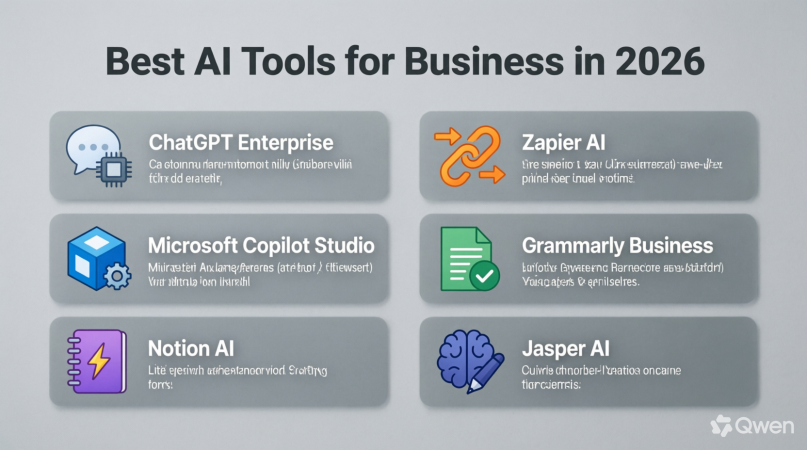
Best AI Tools for Business in 2026: What Companies Are Using
Artificial intelligence (AI) once seemed like something from science-fiction movies. Business owners imagined computers that could “think,” machines that could analyze huge amounts of information, and software that could automate complicated business tasks.
That has changed.
AI business tools are helping businesses work faster and more . A small business owner can use AI to write emails, summarize meetings, create marketing ideas, analyze information, answer customer questions, organize tasks, and automate repetitive work. The best part is that businesses can use these tools without building an AI system from scratch.
AI is no longer just a technology trend. It has become an important part of business productivity and automation.
A freelancer working from home can use AI to save time. An online store owner can use AI for product descriptions and customer support. A marketing agency can use AI tools to create content and analyze campaigns.
This is why more businesses are searching for the best AI tools for business in 2026. The goal is not simply to use the newest technology. The goal is to find practical AI software that saves time, improves productivity, and helps a business serve its customers better.
First, keep your nails clean and dry. Then, apply hand cream and cuticle oil regularly. In addition, file your nails gently to maintain a smooth shape. For example, a fine-grit nail file can help create a neat edge. Finally, protect your hands with gloves during household cleaning.
How AI Helps Small Businesses
Artificial intelligence is changing the way small businesses manage everyday tasks, communicate with customers, and make important decisions. First, AI can automate repetitive work that normally takes valuable time. Businesses can use AI tools to organize information, create content, answer common questions, and support customer service.
In addition, AI can help small businesses improve their marketing. For example, business owners can use AI to generate social media ideas, write product descriptions, create email campaigns, and develop blog content. As a result, a small team can produce more marketing material without spending hours on every task.
Moreover, AI can help businesses understand their customers. AI-powered systems can analyze customer behavior, identify common questions, and highlight purchasing patterns. Therefore, business owners can use these insights to make better decisions about products, pricing, and promotions.
AI for Customer Service
Customer service is another area where AI can provide valuable support. AI chatbots can answer frequently asked questions at any time. For instance, a chatbot can provide information about opening hours, product availability, delivery options, or basic service details.
However, AI does not always need to replace human customer support. Instead, it can handle simple questions while employees focus on more complicated customer concerns. This way, businesses can provide faster assistance while keeping human interaction where it matters most.
AI for Content Creation
Content creation can take considerable time for a small business owner. With AI tools, businesses can generate ideas for articles, advertisements, social media posts, newsletters, and product descriptions.
Furthermore, AI can help rewrite existing content for different platforms. A long blog post can become several social media posts, while a product description can be adapted for an email campaign.
AI for Business Productivity
AI can also improve everyday productivity. For example, business owners can use AI to summarize information, organize ideas, draft documents, and create task lists.
As a result, employees may have more time to focus on creative work, customer relationships, and business growth. At the same time, businesses should review AI-generated information before publishing or using it.
AI and Business Growth
Small businesses often operate with limited budgets and small teams. Because of this, efficient technology can make a significant difference. AI can help reduce repetitive workloads while giving business owners access to tools that were previously available mainly to larger organizations.
Ultimately, AI works best when it supports people rather than simply replacing them. A thoughtful combination of artificial intelligence, human creativity, and careful decision-making can help small businesses become more productive, responsive, and competitive.
This is where AI automation software can make a practical difference.

What Are AI Tools for Business?
AI tools for business are software applications that use artificial intelligence to help companies perform tasks that traditionally required significant manual effort.
These tools can be used for:
- Writing and editing
- Marketing
- Customer support
- Data analysis
- Meeting transcription
- Research
- Project management
- Sales
- Automation
- Document processing
- Image and video creation
- Productivity
The right tool depends heavily on the business.
A restaurant does not need exactly the same AI software as an accounting company. A freelancer does not have the same requirements as a large corporation.
1. AI Writing Tools for Businesses
One of the easiest places for a business to start is with AI writing tools.
Businesses produce enormous amounts of written material every day.
Emails, blog posts, product descriptions, proposals, social media captions, advertisements and internal documents all require writing.
An AI writing assistant can help create a first draft, rewrite existing material, simplify complicated language or generate ideas.
2. AI Marketing Tools
A small business might need to create:
- Facebook and Instagram content
- Email campaigns
- Blog ideas
- Advertising concepts
- Product descriptions
- Customer segments
- SEO content ideas
- Marketing reports
AI can help generate ideas and organize information much faster.
A software company might use AI to turn a long technical explanation into a simple article for beginners.
3. AI Customer Service Tools
Customer service can become difficult as a business grows.
A company might receive hundreds of similar questions every week:
“Where is my order?”
“How do I reset my password?”
“What are your opening hours?”
“Can I change my subscription?”
This is where AI customer service tools can help.
AI-powered chat systems can handle common questions and direct customers toward appropriate information.
For businesses, this can create a faster support experience without forcing employees to answer the same basic question hundreds of times.
4. AI Meeting Assistant Tools
AI Meeting Assistant Tools are smart productivity solutions designed to make online and business meetings easier to manage. These tools can automatically record conversations, create meeting transcripts, summarize important discussions, identify key points, and organize action items. AI meeting assistants can be useful for businesses, freelancers, remote teams, students, and professionals who attend regular meetings. With the right AI meeting assistant, businesses can improve productivity, save time, and keep teams better organized.
5. AI Automation Software
AI automation software can connect different business tasks and reduce repetitive manual work.
A customer completes a form.
The system receives the information.
An AI tool categorizes the request.
A notification is sent to the appropriate employee.
The customer receives an automatic confirmation.
The information is stored for future use.
Business automation does not mean every task should be automated.
The best candidates are usually repetitive, predictable processes where automation can save time without creating unnecessary risk.
6. Best AI Tools for Small Business
Small businesses often have a different problem from large companies.
They don’t necessarily need more software.
They need simple software that produces useful results.
A small company might benefit most from AI tools that help with:
- Customer communication
- Content creation
- Marketing
- Scheduling
- Document management
- Data analysis
- Administrative work
The important question is not:
“What is the most advanced AI tool?”
A better question is:
“What takes too much of our team’s time every week?”
That question can reveal where AI could provide the greatest return.
7. AI Tools for Productivity
Productivity is one of the broadest AI categories.
Modern productivity tools can assist with:
- Summarizing documents
- Organizing notes
- Creating task lists
- Drafting emails
- Researching subjects
- Extracting information
- Preparing reports
- Managing workflows
For an individual professional, even saving 30 minutes a day can become meaningful over an entire year.
For a company with 20 employees, small efficiency improvements can potentially have a much larger impact.
This is why AI productivity tools are increasingly being considered alongside traditional business software.
8. ChatGPT vs Gemini: Which AI Tool Is Better?
The answer is not simply that one tool is universally better.
Different AI platforms may have different strengths, integrations, workflows and pricing structures.
A business should evaluate:
- What tasks it needs to perform
- Which applications employees already use
- Data and privacy requirements
- Team collaboration features
- Available integrations
- Output quality
- Usage limits
- Pricing
Which AI fits our workflow best?
9. AI Software Pricing: What Should Businesses Expect?
One of the biggest concerns for companies is AI software pricing.
Some AI tools offer free plans. Others use monthly subscriptions, usage-based pricing or business plans.
Suppose a tool costs $30 per month.
A better approach is to start with one or two important business problems.
Measure the result.
10. How Businesses Should Choose AI Software
The AI market moves extremely quickly.
A tool that receives attention today may have several competitors tomorrow.
Features
Ease of use
Can employees learn it quickly?
Integration
Does it work with the systems your business already uses?
Security
How does the provider handle business information?
Pricing
Is the cost reasonable compared with the expected benefit?
Scalability
Can the tool continue to work as the company grows?
Support
Is useful documentation or customer support available?
These questions can prevent businesses from spending money on software they barely use.
The Human Side of AI
Businesses are made of people.
The strongest companies are likely to be those that combine technology with human judgment.
AI can produce a draft.
A person can improve it.
AI can summarize information.
A person can decide what it means.
AI can identify patterns.
A person can decide what action to take.
That partnership is where AI becomes genuinely useful.
What Will AI Business Tools Look Like in the Future?
The biggest change may not be one spectacular AI application.
It may be the gradual disappearance of small repetitive tasks.
A salesperson could research a prospect, prepare notes and draft an email.
A marketing employee could analyze campaign data and generate a report.
A customer service representative could receive an automatic summary of a customer’s previous interactions.
A business owner could ask for a simple explanation of complicated company data.
Final Thoughts
The search for the best AI tools for business in 2026 is ultimately not about finding one magical application.
It is about finding the right tools for the right problems.
AI writing tools can help businesses communicate faster. AI marketing tools can support content and campaign planning. AI customer service tools can handle repetitive questions. AI meeting assistants can reduce administrative work. AI automation software can connect workflows. Productivity tools can help employees spend less time on repetitive tasks.
Frequently Asked Questions
The best AI tool depends on the business’s specific requirements. Common categories include AI writing, marketing, customer service, meeting assistants, productivity software and business automation tools.
AI tools can help small businesses with everyday tasks like writing content, helping customers, marketing, research, taking meeting notes, organizing data, and automating work.
AI software prices can be different. AI tools have different prices.
Time needed: 5 minutes
- What should a business look for in an AI tool?
Businesses should check the tool’s features, price, safety, privacy, and ease of use.

Download > credit debit pro
https://play.google.com/store/apps/details?id=com.creditdebitpro.app&pcampaignid=web_share